Wednesday, 5 April 2017

Precedent

Precedent

Stare Decisis

The precedent is based upon stare decisis, which means "Let the decision stand." According to some, the full statement of the principle, however, is stare rationibus decidendis, which translates into: "Let the reasoning of the decision stand." According to Webb and Holland, the precedents are not merely a comparative process of similarities and differences rather it embodies the art of interpretation; the art of putting forth the principle to be derived from each case. In a strict sense, which implies to the courts of Pakistan and England as well is that precedents are of binding nature. Hence, it provides precedents a great authority and doctrine of precedents is based on hierarchy of courts.

Obiter Dicta

Irrelevant remarks made by the judges for a case.
or
In Latin means "by the way".
 In a court opinion, obiter dicta include, but are not limited to, words "introduced by way of illustration, or analogy or argument.

Features of Obiter Dicta

1.      The judge will explain the ratio and how and why he reached his decision in this case.
2.      He may make speculative comments on how the decision might have differed if the facts of the case had been slightly different.
3.      He may discuss other pieces of law which may have been applied to this case and any general principles or cases that apply.
4.      In similar cases, obiter statements are clearly persuasive and do not need to be followed.

Debate of Obiter Dicta

The obiter dicta or simply dictum are merely persuasive authority to support one's opinion or whatever they address. Such as this, dicta have no binding authority that a court has absolutely to follow. They are persuasive statements or judicial observations only.  

Ratio Decidendi

The judge's reason for coming to a decision.

Features of Ratio Decidendi

1.      The most powerful tool for a lawyer if used in its authentic essence.
2.      The judge chooses the relevant law and applies this to particular facts of the case and is known as the application of law to fact.
3.      The ratio is binding and must be applied where the fact of the latter case are the same or sufficiently similar.
4.      In the Supreme Court and Courts of Appeal the cases are heard by more than one judge. Each judge may provide a separate judgment outlining the reasons for deciding the case. This could lead to a situation where there could be more than one ratio decidendi.


A judicial statement can be ratio decidendi only if it refers to the crucial facts and law of the case. Statements that are not crucial, or which refer to hypothetical facts or to unrelated law issues, are obiter dicta.

Thursday, 30 March 2017

Sociology Chapter 1-2 Notes

Chapter I

History of Sociology 

Prior to the birth of sociology, philosophers and theologians were mostly concerned with imagining the ideal society that is life as it ought to be. None attempted an analysis of real society as it was. Sociology is rooted in the works of philosophers including Plato, Aristotle, and Confucius. Some other early scholars also took perspectives that were sociological.  The Enlightenment thinkers took a great amount of interest in this subject and hence set a stage for the sociologists that would follow. The Enlightenment thinkers were the first one to put up a general explanation of social world. They were able to detach themselves, at least in principle, from explaining some existing ideology and attempt to lay down general principles that explained social life. Writers and philosophers of this period included well-known persons like: John Locke, Hume, Voltaire, Kant, Monstesquieu, Hobbes and Rousseau. Sociology as a discipline emerged in response to social problems that plagued Europe in the late 1700s and early 1800s.

August Comte

  • Coined the term "sociology" in 1836. 
  • He was a french social philosopher. He was originally an engineering student. 
  • Known as the Modern father of Sociology. 
  • His literary works include Positive Philosophy, The System of Positive Polity.  
  • Comte studied society's history in three divided intellectual stages. The first one was Theological stage which included medieval period in which society was seen as following the will of deity. The second, or metaphysical stage is from the Enlightenment and focused on the forces of 'nature' but not God to explain social events. The third one was positivistic, or scientific stage. 
  • His broad division of society is still widely followed which is as Social Statics (social structure) and Social Dynamics (social change). 
  • During Comte's lifetime, scientists were learning more about the laws that govern the physical world. For example, in the area of physics, Sir Isaac Newton had developed the law of gravity. In such a way, many other Fields such as biology were exceeding in advancement as well. Just as there were testable facts regarding gravity and other natural laws, Comte thought that sociology could draw on the same resources as the natural sciences, namely observations experimentation and comparison. It was in this context that Comte introduced the concept of positivism to sociology -- the idea of turning speculation about human society into a scientific discipline. He believed that with this new understanding, sociologists can understand the problems of world and build a safer and better world for people to live. 
  • Comte died in 1857. He was 60 years old. 

Harriet Martineau

  • Comte's Positive Philosophy was translated into English by Harriet Martineau. Her work impressed Comte so much as a result of translation that he had her abridgement re translated back into French. 
  • Martineau was a prolific writer and a best selling author as well who mainly focused on writing about Social issues of society. 
  • Her work earned her recognition as the first female sociologist and "Mother of Sociology."
  • She got better education than most of female students at that time because her parents were Unitarians. She spent most of time reading books and writing after losing most of her hearing power at the age of 12. 
  • She authored hundreds of books, articles and editorials on topics including literature, children's literature, politics, history, religion, economics, and sociology. 
  • Overall her works laid down the groundwork for both the interpretive and feminist paradigms of modern sociologists. 
  • He literary works include: Society in America, How to Observe Morals and Manners, Eastern Life: Past and Present, Household Education. 

Abu Zaid Abdal Rahman Ibn Khaldun

  • He advocated the empirical research and has been called an excellent deductive sociologist who was "more positivistic than Durkheim."
  • He was born in Tunis, North Africa, he worked for North African princes as emissary and administrative positions. 
  • Regarded among the modern fathers of historiography, and economics. He is also known as the Muslim father of sociology.
  • He was the father of Arab Social Sciences. 
  • Coined term Ilm-ul-imraan for Sociology. 
  • Introduced concept of Al-asbiyah which means Group Solidarity. 
  • Literary works: Al-Muqqadimah (The Rise and Fall of Empires) 
  • Ibn Khaldun lived the last years of his life in Egypt as a scholar, teacher and magistrate. 

Chapter II

  • A theory is the analysis and statement of how and why a set of facts relates to each other. In sociology, theories help us understand how social phenomena relate to each other. Theories help sociologists explain why and how society works. through the use of theory, they work to answer such questions as "why are things as they are, what conditions produce them, and what conditions change them into something else? If we have such a theory we will at last be in a position to know what we really can do about the shape of our society. By understanding the real causes of how and why things operate as they do, we can find ways to address the things that need improvement. 

Sociological Perspective

  • Sociological Perspective means an approach to understanding human behaviour by placing it within its broader social context.  It is a set of assumptions about reality that underlies the questions we ask and the kinds of answers we arrive at a result. For example: seeing strange in the familiar is a common observation when different people or groups visualise a similar subject. 
  • Paradigms are the broad assumptions about how the world works. On such basis of paradigms, scientists develop disciplines. These paradigms guide the way social scientists develop theories, conduct research and evaluate evidence. Since these paradigms encompass assumptions about how various parts of the world are connected, they guide responses to perceived situations and solutions to any problems that are identified. 
  • An example in the field of medicine illustrates this concept. (1) Very early theories regarding diseases consisted of ideas as satanic state of mind, magic or deities as the cause of such a condition. In order to treat them bloodletting (draining blood from the body) or a procedure called trephination in which holes were made in the skull using sharp stones. (2) Hippocrates popularised the theoretical paradigm that disease was supernatural phenomenon. He developed that diseases occurred due to imbalance of four humors as hot, cold, dry, and wet within the body. Based on this theories, methods were developed to treat people such as cool someone with a heat-related illness. This remained dominant theory for centuries. (3) The germ theory was guided was Louis Pasteur, and after this research treatments began to focus on fighting the bacteria. Sometimes all of these treatments worked, regardless of whether evil spirits were actually released, humors were rebalanced, germs were killed, or some other mechanism, was the actual cause of the recovery. Results, however tend to explain according to the prevailing paradigms of the time. 
Sociological perspectives are divided into two groups as Macro-level and Micro-level of orientations in society. 

Macroperspectives 

This focuses on the broad social structures. These look at social processes throughout the society. For example, the economy, the government, and the health-care system. Sociologists are interested in the fact that how these macro-level orientations interrelate, fit together and any troubles or stress within these interrelationships. 

Microperspectives

A focus on social interaction in specific situations. These focus on the patterns of individual interactions. For example, the social theorists who take a micro perspective under focus examine the daily interaction of a person. They are interested in why and how individuals relate to each other, how our interactions are shaped by larger society and how these can in turn change the society.

Feminism 

Macro level approach. Feminism is the advocacy of social equality for men and women (in education and employment) in opposition to patriarchy and sexism. Feminism views the personal experiences of women and men through the lens of gender. How we think of ourselves (gender identity), how we act (gender roles) and how are our sexes' social standing (gender stratification). Stratification means society's categorisation of people into socioeconomic class or a region. Are all rooted in the operation of our society. Feminist movements have campaigned and continue to campaign for women's rights, including the right to vote, to hold public office, to work, to earn fair wages or equal pay, to own property, to receive education, to enter contracts, to have equal rights within marriage, and to have maternity leave. Feminists have also worked to promote bodily autonomy and integrity, and to protect women and girls from rape, sexual harassment, and domestic violence.

gender equity symbol

Gender Equity

Every gender has different needs, which are of contrasting natures. Hence their needs shall be fulfilled according to their needs. This requires ensuring that everyone has access to a full range of opportunities to achieve the social, psychological and physical benefits that come from participating and leading in sport and physical activity. Therefore, some activities may be the same as those offered to boys and men, some may be altered, and some may be altogether different.

Major Sociological Perspectives

There  is  no  clearly  identifiable  date  when  sociological  theory  began.However, the mid-to-late 1800s marks the period when social thought turned to what we today call sociology.There  are  currently  three  major  theoretical  paradigms  in  sociology:  the  structural-functionalist  paradigm,  the  social-conflict  paradigm,  and  the symbolic-interactionist paradigm. No one of these three perspectives is singularly “right” or “wrong.” Each provides a different way to view and analyze society. They can reveal different issues and suggest different answers totackling any problems they identify. Two of the major paradigms, the structural-functionalist and the social-conflict perspective, take a macro perspective on society. The third perspective, symbolic-interactionism, takes a micro perspective.

Structural Functionalism

Structural-functionalism  is  the  earliest  sociological  paradigm.  It  is rooted in the scientific advances of the physical sciences occurring in the nineteenth  century.  Based  on  these  advances,  Herbert  Spencer approached  the  study  of  social  structures  through  an  “organic  analogy”  that emphasized evolutionary laws. In this model, Spencer viewed society as being similar to a body. In the most simplistic terms, just as the various organs in the body work together to keep the entire system functioning and regulated, the various parts of society (the economy, the polity, health care, education, etc.) work together to keep the entire society functioning and regulated.Spencer also saw similarities in the way physical bodies and societies evolve.Spencer actually coined the term survival of the fittest,which is often incorrectly attributed to evolutionary biologist Charles Darwin.

Spencer  influenced  early  French  sociologist  Emile  Durkheim. Durkheim took this organic analogy and refined it into a perspective that would become structural-functionalism.The perspective is also called functionalism,or the functionalist paradigm.This paradigm views society as a complex system of interrelated parts working together to maintain stability. According to this perspective; (1) a social system’s parts are interdependent; (2) the system has a “normal” healthy state of equilibrium, analogous to a healthy body; and(3) when disturbed, the system parts reorganize and readjust to bring the system back to a state of equilibrium. Any changes in society occur in structured, evolutionary ways.
Durkheim realized that society influences our human actions but that society is also something that exists beyond individuals. He felt that society must be studied and understood in terms of what he called social facts.These social facts include laws, morals, values, religious beliefs, customs, fashions, rituals,and  the  myriad  cultural  and  social  rules  governing  social  life. Durkheim saw this system of social facts as making up the structure of society.

Functionalism has been very influential in sociology. It was especially popular in the United States when championed by Harvard sociologist Talcott Parsons  (1902–79)  during  the  1940s  and  1950s.  Parsons,  profiled  below,  is 

Robert K Merton a student of Talcott Parsons, also showed that social patterns are complex, with the various parts of society fulfilling different types of functions. Some functions, which Merton called manifest functions,are obvious and intended.Other functions, called la-tent functions,are less recognized and unintended.These functions may be either beneficial or neutral. However, some functions may be undesirable.These are called social dysfunctions. A simple illustration of these concepts is the widespread use of cars in America  and  many  other  countries.  Cars  provide  transportation and status. Both are manifest functions. Cars also provide personal autonomy, allowing drivers to come and go as they please, on their own schedules.This is a latent function of the vehicular transportation system as it currently exists. However, cars also pollute the environment. Thus, relying on cars as a major means of transportation is also dysfunctional in that regard.Structural-functionalists also recognize that as one part of the system changes, other parts of the system have to readjust to accommodate the change that has taken place elsewhere. A change in one part of the system may have manifest, latent, and dysfunctional consequences. For example, pharmacies, bookstores, dry cleaners, and restaurants have seen business decline as bar business increased.
For example, Religion:
Menifest:        Social solidarity moral values
Latent:            Purpose of life, satisfaction
Dysfunction:  Terrorism and extremism 

Social Conflict Theory 

The other major macro-sociological theoretical framework in sociological  theory  is  the  social-conflict  paradigm,  also  referred  to  as  the  conflict  perspective. Social-conflict  theory focuses  on  competition  between  groups.Whereas functionalists focus on balance and stability within a social system,conflict theorists view society as comprised of social relations characterized by inequality and change.According to conflict theorists, groups are constantly competing for unequally distributed resources, such as wealth and power, with each group seeking to benefit their own interests. In this scenario, one or a few groups control these  resources  at  the  expense  of  others.  Thus,  these  theorists  look  at  social structures and ask, “Who benefits?” This constant conflict between groups also results in social change.
The works of Karl Marx (1818–83) are often credited with providing the sociological roots of the conflict perspective.Marx (profiled below) was born in Prussia, now Germany, during the stormy period in which western Europe was transitioning from feudalism to capitalism. The Industrial Revolution was in full swing, and Marx observed inequality throughout the growing capitalist society.The economics of capitalism, he felt, resulted in social classes that were constantly  in  competition  for  society’s  limited  resources.  Marx  saw  rich  factory owners who obtained their wealth from the labor of factory workers who were paid little, often toiled long hours in dangerous conditions, and frequently lived in crowded and unhealthy spaces. Society, as Marx saw it, was an ongoing struggle between the classes: the “haves” (illustrated by the factory owners) and the“have  nots”  (illustrated  by  the  workers).  The  result  was  social  conflict  and change as those without resources challenged those holding the resources for apiece of the proverbial pie. Often times Marx is criticized for not talking about Middle class of that time, but sadly there was none due to drastic differences among social classes. Overall Marx focused on issues like social class, class conflict, class consciousness, means or modes of production, capitalism, and communism.
Another philosopher Max Weber talked about formal organisations, bureaucracy, concept of three P's (power, property, prestige), social action theory, authority, social class, and theory of rationalization. 

Symbolic Interaction-ism 

Symbolic interactionism is the prevailing micro-theoretical frame work in sociological theory. As a micro-level perspective, symbolic interactionism focuses on patterns of individual interactions.Although sociologists working in this tradition recognize that larger social structures exist and are important in shaping our lives, they point out that society is actually created by people inter-acting together on a daily basis. It is these smaller interactions that actually makeup the larger social structures that are of the focus of functionalists and conflict theorists. According to this perspective, society and these larger social structures must be understood through studying social interactions that are based on shared understandings, languages, and symbols, segregation of men and women, dress codes etc.. A symbol is something that stands for,represents, or signifies something else in a particular culture.Symbols can be anything—gestures, words, objects, or events—and they can represent any number of others things, ideas, events, or emotions. Symbolic interactionists argue that we are able to interact with others be-cause we create symbols and learn to interpret what those symbols mean in our interactions. Thus, symbolic interactionism is sometimes referred to as interpretive theory.Social change occurs as people develop a shared understanding that a change needs to take place and interact to make that change happen. For example, a word has no inherent meaning. A word is merely a simple noise but it becomes a "word" when we attach certain meanings to it. 


What is Law


Normal Law v. Positive Law

Positive law is made by people.  Natural law comes from sources that are universal.  To many people (for example, to Thomas Jefferson in the Declaration of Independence) the source of natural law is God.  Natural law is universal; it applies to everyone.  Positive law only applies to those people who are the subjects or citizens of the government that creates the law.  Positive law must be written down.  Natural laws are unwritten laws.  In short, then, positive law must be made by a given government and it relies on the government for its power.  Natural law is not made by people and has moral power regardless of whether a government recognizes it and makes it into positive law or not. According to the University of Louisiana at Lafayette, natural law refers to those laws that derive their legitimacy from moral reasoning and are based on what is believed to serve the best interests of the common good while positive laws are those that obtain their legitimacy through legislative means and are enforced by civil or political authority.


https://davegj13.wordpress.com/2010/06/12/natural-law-vs-positive-law/


What is law? 
Firstly—in all societies from primitive to the present day of highest peak of civilization-in one or other from, there is law. The difficulties not only lie in the fact of development rather in characteristics also. In different societies, ‘law’ means and includes different things.
Under Hindu Dharma—It is ‘Dharma’ 

Under Islamic—It is ‘Hukum’

Under Roman—It is ‘Jus’

Under French—It is ‘Droit’.Secondly, some defines ‘law’ on the basis of its ‘sources’. Some defines it on the basis of its ‘nature’.Thirdly—We all know that, law is a social science. It grows and develops with the society. The fast social and scientific development of modern era has created new problem. To keep pace with the society, the function and scope of law remains always changing. Therefore, it is difficult for a given definition of law at a particular time to remain valid for all times
Law is the part of established thought and habit which has been accorded general acceptance, and which is backed and sanctioned by the government of body politic. 
The law consists of the rules recognized and acted on in the courts of justice. 
Jurisprudence (Juris and prudentia) is "understanding or science of law"
Justice is the end, law is merely the instrument and the means; and the instrument must be defined by the reference to its end. 
Deciding according to pre-determined rules conveys a sense of fairness and justice.
Administering justice through pre-ascertained rules is therefore the primary function of law. 

What is Islamic law?
ShariaSharia law, or Islamic law is the religious law forming part of the Islamic tradition. In Arabic, the term sharīʿah refers to God's divine law and is contrasted with fiqh, which refers to its scholarly interpretations.

Wednesday, 29 March 2017

Economics Notes

Characteristics of Wants 

  1. Human wants are unlimited. 
  2. Humans wants reappear. Most wants recur. If they are satisfied once, they arise again after a certain period. We take food and our hunger is satisfied. But after a few hours, we again feel hungry, and we have to satisfy our hunger every time with food. Therefore, hunger, thirst, etc. are such wants which occur time and again.
  3. They compete with each other (eg pepsi v. coke)
  4. Wants are complementary. Wants are competitive but a few wants are complementary to each other. To satisfy one want for a good, we have to arrange for another good also. For example, the want for a car can be satisfied only when we fulfill the want for petrol also. Such wants are called complementary.
  5. Certain wants become habits. For example, the continuous use of opium, liquor, cigarettes, etc. become habits.
  6. Some wants are alternative. We can satisfy our hunger either with rice, bread, vegetables, fruit, meat, eggs, milk, etc.
  7. Hidden wants are those about which we do not know apparently. They lie hidden in our sub-conscious mind. But per chance, when we come across it or get satisfaction from the use of certain things, it becomes a necessity or a want for us. For example, a worker goes to his factory on foot and he does not need a bicycle. Suppose he gets a bicycle in the lottery, then he thinks that the bicycle was an important want for him.
  8. Certain human wants are relative to time and place. We need woollens during the winter and cotton clothes during the summer. 
  9. All our wants are not of equal importance. Certain wants have more intensity whereas other wants have less intensity. Food, clothes and shelter are more urgent wants than radio, scooter, etc.
  10. Income of the individuals also affects their wants. As income increases, wants also increase. The wants of rich and poor people are not the same.
  11. Wants are also affected by advertisement of goods and services made by producers and sellers. When we see an advertisement about a new product in a daily newspaper or TV, there arises a want for it.

Goods & Services

Goods are items that are tangible, such as books, pens, salt, shoes, hats and folders and Services are activities provided by other people, such as doctors, lawn care workers, dentists, barbers, waiters, or online servers.
Types of Goods
Consumer goods are items people purchase to satisfy their needs and wants, such as food, shelter, and clothing. Producer goods refer to resources producers need to create goods, like cotton and steel.

Types of Services

Some types of services include educational services, communication services, transportation services and health services.

Supply and Demand

Since goods and services are scarce, their price is determined by supply and demand. Supply refers to the total amount of the goods or services that are produced, and demand refers to the total amount that consumers wish to consume.

Deductive & Inductive Approaches

There are two method of reasoning in theoretical economics. They are the deductive and inductive methods.

Deductive Method

Deduction Means reasoning or inference from the general to the particular or from the universal to the individual. The deductive method derives new conclusions from fundamental assumptions or from truth established by other methods. It involves the process of reasoning from certain laws or principles, which are assumed to be true, to the analysis of facts. Deduction involves four steps: (1) Selecting the problem. (2) The formulation of assumptions on the basis of which the problem is to be explored. (3) The formulation of hypothesis through the process of logical reasoning whereby inferences are drawn. (4) Verifying the hypothesis.

OR

Deductive economics starts with a set of axioms about economies and how they work, and relies on these principles to explain individual cases or events. Supply and demand analysis, a staple in any introductory economics course, is an example of deductive reasoning because it involves a set of generally accepted principles about demand and supply. To summarize, deduction in economics starts with a generally accepted principle and proceeds to the specific.

Inductive Method

Inductive reasoning in economics does the reverse of deductive reasoning; namely, it begins with an individual problem or question and proceeds to form a general principle based on the evidence observed in the real world of economic activity. For example, an economist who asks if a government program of public works spending will stimulate a region's economy will proceed to research the issue, collect and analyze data, and based on conclusions, form a general theory about the economic impact of fiscal policies.Need not say; when you employ inductive method in your analysis, you need to collect relevant statistical data. These statistical data serve as the basis for generalizations.

Positive & Normative Economics

 Positive economics is objective and fact based, while normative economics is subjective and value based. Positive economic statements do not have to be correct, but they must be able to be tested and proved or disproved. Normative economic statements are opinion based, so they cannot be proved or disproved.

Positive

Positive statements are onjective and verifiable facts about some economic aspects whether they are true or false is immaterial. For example there is 10% unemployment is a positive statement. It maybe right or wrong but it is verifiable. 

Normative

Normative economics uses valued judgements & personal opinions about what the economy should be like or what particular policy action should be recommended. It involves the question of what is good or bad. 

Characteristics of Utility 
1. Utility has no Ethical or Moral Significance                                        
A commodity which satisfies any type of want, whether moral or immoral, socially desirable or undesirable, has utility, i.e., a knife has utility as a household appliance to a housewife, but it has also a utility to a killer for stabbing somebody.

2. Utility is Psychological
 Utility of a commodity may differ from person to person. Psychologically, every consumer has his likes and dislikes and everyone determines his own level of satisfaction
For example: 
a strictly vegetarian person has no utility for mutton or chicken.

 3. Utility is always Individual and Relative.
Utility of a commodity varies in different situations in relation to time and place. Even the same consumer may derive a higher or lower utility for the same commodity at different times and different places. For example—a person may find more utility in woolen clothes during the winter than in summer or at Kashmir than at Mumbai.

4. Utility differs from usefulness-
 many commodities like opium liquor, cigarettes etc. have demand because of utility, even though, they are harmful to human beings. 

5.Utility cannot be Measured Objectively:
Utility being a subjective phenomenon or feeling of a consumer cannot be expressed in numerical terms. So utility cannot be measured cardinally or numerically.

 6. Utility Depends on the Intensity of Want:
A want which is unsatisfied and greatly intense will imply a high utility for the commodity concerned to a person.In other words, the more of a thing we have,  the less we want it.

  7. Utility is Different from Pleasure:
A commodity may have utility but its consump­tion may not give any pleasure to the consumer, e.g., medicine or an injection. An injection or medicinal tablet gives no pleasure, but it is necessary for the patient.


Can Utility be Measured?
Utility is a psychological concept. This is different for everyone. So, it can't be measured directly. Professor Marshall has said that “Utility can be measured and its measuring rod is ‘money'. The price which we are ready to pay for an article is practically it's utility.
For example:
If I am ready to pay Rs. 1500 for a watch and Rs. 2,000 for a Radio. Then I can say that I derive utility from the watch up to the value of Rs. 1500; and from Radio up to the value of Rs. 2000.
But Prof. Hicks, Allen and Pareto have not supported Marshall’s view of measuring utility.
They are of this opinion that measuring of utility is not possible because of the following reasons:
(i) Utility is personal, psychological and abstract view which cannot be measured like goods.
(ii) Utility is different for different people. Utility is always changeable and it changes according to time and place. Therefore, it is difficult to measure such thing which are of changeable nature.
(iii) Further, measuring material ‘money is not static. Value of money always changes, therefore, correct measurement is not possible.

Kinds of Marginal Utility—Marginal utility is of three kinds: 
(i) Positive Marginal Utility,
(ii) Zero Marginal Utility,
(iii) Negative Marginal Utility.
It is a matter of general experience that if a man is consuming a particular goods, then receiving of next unit of goods reduces the utilities of the goods and ultimately a situation comes when the utility given by the goods become zero and if the use of the goods still continues, then the next unit will give dis-utility. In other words it can be said that we will derive “negative utility”.


Difference between stock and supply:
Stock is the quantity of output which a seller/business has with him and has not yet been brought for sale: where supply is the quantity of output brought from the existing stock of sale at a certain price in the market.
e.g.   (i) stock = 1000 kg of rice
        (ii) supply = 200 kg for sale at Rs. 40 per kg.
Supply is a schedule of the amount of a good that would be offered fore sale at all possible price at any period of time; e.g., a day, a week, and so on”. Acc go Meyer. 

 Stock means the total quantity of a commodity this exists in a market and can be offered for sale at a short notice".

The supply and stock of a commodity in the market may or may not be equal if the commodity is perishable, like vegetables, fruits, fish, etc; then the supply and stock is generally the same.

Law of Demand

Definition:

The law of demand states that other factors being constant (cetris peribus), price and quantity demand of any good and service are inversely related to each other. When the price of a product increases, the demand for the same product will fall.

Explanation

A consumer may demand one dozen oranges at $5 per dozen . He may demand two dozens when the price is $4 per dozen. A person generally buys more at a lower price. He buys less at  higher price. It is not the case with one person but all people liken to buy more due to fall in price and vice versa. This is true for all commodities and under all conditions. The economists call it as law of demand. In simple words the law of demand states that other things being equal more will be demanded at lower price and lower will be demanded  at higher price.

Individual Demand & Market Demand

The demand of a person is called individual demand. The demand of families and societies are called as market demands. Prince decreases, individual demand increases. The market demand is the sum of individual demand. 

Why demand curve falls?

There are three reasons for it as listed below: 
  1. (purchasing power) Income Effect : When price of a commodity falls, consumer's real income rises that is he can now purchase more of the commodity with the same income.
  2. Substitution effect (when the price is lowered among two choices, you choose the cheaper one and the income effect increases) 
  3. Number of buyers increase. 

Assumptions

  1. Income of the consumer does not change, in order to sustain the law
  2. The taste does not change of the buyers 
  3. Price of related good should be same
  4. Population does not increase
  5. People do not expect early change in prices 
  6. Quantity of money does not change

Exceptions or Exceptional Demand Curve

  1. Giffen good is typically an inferior product that does not have easily available substitutes, as a result of which the income effect dominates the substitution effect.Giffen goods are quite rare, to the extent that there is some debate about their actual existence.
  2. Hoarding 
  3. Status Symbol A status symbol is an object which is meant to signify its owners' high social and economic standing.

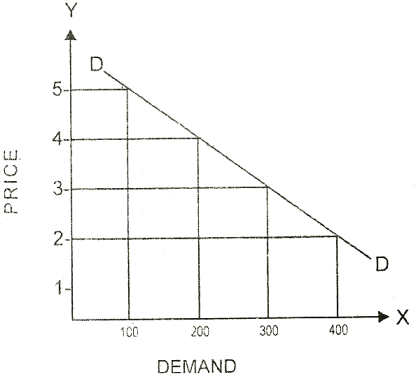
Demand schedule

Price in dollars.Demand in Kg.
5100
4200
3300
2400
The table shows the demand of all the consumers in a market. When the price decreases there is increase in demand for goods and vice versa. When price is $5 demand is 100 kilograms. When the price is $4 demand is 200 kilograms. Thus the table shows the total amount demanded by all consumers various price levels.

Diagram

law-of-demand-diagram
There is same price in the market. All consumers purchase commodity according to their needs. The market demand curve is the total amount demanded by all consumers at different prices. The market demand curve slopes from left down to the right.
Indifference Curve 

Definition: An indifference curve is a graph showing combination of two goods that give the consumer equal satisfaction and utility. 
OR
An indifference curve represents a series of combinations between two different economic goods, between which an individual would be theoretically indifferent regardless of which combination he received.

Each point on an indifference curve indicates that a consumer is indifferent between the two and all points give him the same utility. Indifference curves are a graphical representation of how much value an individual receives from various combinations of consumption. We measure value through the catch-all term “utility”, an concept for the value, well-being, satisfaction, benefit, etc. that someone receives. 

Uses:
Used in contemporary microeconomics to demonstrate consumer preference and the limitations of a budget.
Can be useful for modeling consumer reactions to income, welfare, or wage changes (read: all labor-related) but are otherwise hard to create because most people are spending their income or time on more than 2 things.
Graph:
This is what an indifference curve looks like. Along this line, the individual in question will receive the same amount of satisfaction for any different combination of Item A and B. The slope of the indifference curve is known as the marginal rate of substitution or MRS. MRS shows the marginal utility the individual will gain (or lose) from moving up or down on the indifference curve. Marginal utility is simply the benefit the person gains from consuming an additional unit of a good. You will recall the indifference curve plots 2 different goods, so the marginal rate of substitution is telling us “how much does this person prefer good X to good Y? What is the value they get from an additional unit of this good?” The MRS is always negative for the same reason that indifference curves are convex: diminishing marginal utility. 

Diminishing marginal utility
The indifference curve is convex because of diminishing marginal utility. When you have a certain number of bananas – that is all you want to eat in a week.

Understanding through tables:
Suppose all the following combinations are equivalent:

Units of Orange Units of Apple   
4 1   
3 2   
2 3   
1 4  

Explanation:
Let us take the example of a consumer purchasing two goods only, apple and orange. He may prefer apple to orange but if orange becomes relatively cheap he may want to eat a few more units of it. If the price of apple becomes much cheaper he may give up orange altogether.
On the other hand, if the price of apple becomes very high he may be forced by lack of means to give up apple. Between these two extremes he will purchase both apple and orange, but will vary the proportions according to relative prices so that he obtains the advantages of small price changes of either commodity. It follows, therefore, that there are more than one combinations of apple and orange which are equally satisfactory to him.
Graphical Representation:
The our combinations are represented by small circles the figure. Apple is represented on the X- Axis, while orange is represented on the Y- Axis. The curve I1 is called an indifference curve.
Thus an indifference curve may be defined as a curve which shows combinations of goods which are equivalent to one another. It is a locus of points sharing alternative combinations of apple and orange which give the same satisfaction to the consumer. The consumer has no reason to prefer any of the combinations on the curve to any other on the same curve. He is indifferent as to  which of these combinations he uses. Each indifference curve is an equal-utility curve.
Assumptions:
The indifference curve approach is based upon the following assumptions:
1. Non-Satiety: A rational person will prefer a larger quantity of a good than a smaller amount of it. It is assumed that the consumer has not yet reached the satisfaction point in respect of competition of a good.
2. Transitivity: The consumer is supposed to be consistent about his tastes and preference. For example if he prefers A to B and B to C then it follows that he also prefers A to C. This assumption is called Transitivity.                                                                                                    3. Diminishing Marginal Substitutability: Suppose a consumer buys orange and apple. It can be assumed that as more and more of units of apple are substituted for orange, the consumer will be willing to give up fewer and fewer units of orange for additional units of apple. As the quantity of orange consumed increases, more of it will be required to compensate for loss of apple. This follows from the principle that as the consumption of orange increases the desire for it will fall and as the consumption of apple decreases the desire for it will increase.
Therefore, the marginal rate of substitution of orange for apple increases as the quantity of orange increases relatively to apple. Alternatively we can say that the marginal rate of substitution of orange for apple diminishes as the supply of apple diminishes. This is called the Principle of Diminishing Marginal Substitutability. It is assumed that the two goods are not perfect substitutes for one another and that want for the goods are not satiable.
The Principle of Diminishing Marginal Substitutability corresponds to the older law of diminishing marginal utility.
Properties:
1. Indifference Curves Have a Negative Slope:
When the quantity of one commodity in a combination of two goods increase, the quantity of the other commodity must decline. An indifference curve must slope downwards from left to right
2.An indifference curve which lies above and to the right of another shows preferred combinations of the two commodities. This means that indifference curves with larger bundles of goods lie further up and to the right than indifference curves with smaller bundles. In general, movements from left to the right in the commodity space or on the indifference map correspond to increases in utility.
3. It cannot Intersect or Touch Another Indifference Curve
4. Indifference Curves are Convex to the Origin

Conclusion:
Thus it is concluded that:
(i) each indifference curve is a distinct line;
(ii) it slopes downwards from left to right and
(iii) it is convex to the origin.


    STOCK
SUPPLY
Meaning
Stock refers to entire quantity of a commodity which is in the custody of the seller. So it is the potential supply.
Dependence
Stock depends on production.
Relationship
Stock can be greater than the supply.
(a) For perishable commodities the stock and the supply can be the same.
(b) For durable commodities, the stock can be more than the supply.
4.      Order of existence
Stock comes before supply
Supply refers to the quantity of a commodity offered for sale at a given price and at a given time and place.
Supply depends on stock and price.
Supply cannot be greater than the stock.
(a)    Supply is either equal or less than the stock.
Supply follow stock there cannot be supply without stock.

Economic Laws

For the basis of economic laws, as early as 18th century, Adam Smith (writer of 'Wealth of Nations') pondered over economic effects of mercantile laws. From this point onwards, the field of Economics has put forth the leverage on its own collection of observations and laws in an official mannerism. Economic laws which are also known as Economic Principles are drawn with keen interest of human nature by realizing the human and physical nature with the aid of reasoning. But the laws of Economics are true under certain conditions as if certain conditions have to be fulfilled completely in order to reach the exact, authentic laws as those of physical sciences. In the long run of life of man striving to fulfill his wants, he follows certain principles with a regularity while engaged in the economic activity, such set of principles are called Economic laws.
In the words of Roscoe Pound, he said,
"Law is experience developed by reason and applied continually to further experience."
Following are the top fundamental laws of economics:
1)    The more the production of commodities, trades, goods and services. The more will be value of money.  In order to sustain prosperity in society and also to increase the level of competency among other nations, this is one of the most basic laws. The production of goods, services and etc must continue onwards to increase the value of money.  The rate of production should always be higher than consumption.

2)    Productivity determines the Wage Rate.  As the labors are offered wages for working per hour, it is output per hour.

3)    Reward the Producers of the commodities, trades, goods and services and only the Producers.1 In order to flourish the society, it is important to follow the mentioned laws. As if this third law is not followed properly the nation maybe at brink of depression, war or various instabilities. 

4)    Nothing is for Free. There are no meals served for free.  For example, taxes which are collected from everyone on each and every item bought are a need of Government. Likewise, to run an economically sound society, capital needs to be made. If this law is violated, no profit will be made and ultimately the needs of society will not be fulfilled. In an even generalized society there shall be no profit or loss made by the companies and mega factories , hence all would earn the same amount of interest. But in order to grow the economy,  variation must take place. As profit is the entrepreneurial bonus.

Likewise, there are many more laws which are made according to the need of situation. Following are the contrasting aspects among Economic laws and other laws.

Economic Laws Vs Physical Laws

Definition
 The Economists of this modern age deal with the behavior, wants and needs, activities of men in society.


Definition
The Natural sciences (physical laws) deal with various scientific theories and proved experiments regarding atoms, molecules, etc.

Inconsistency
 These laws are not consistent, as the human nature is bound to differ from one another in certain ways. Hence there are no exact laws in this field of studies.


Consistency
These laws are consistent, as the nature of atoms, molecules and their behavior through many experiments has been exact and authentically constant.

Application
Can be applied on average conditions.


Application
Are true under all related conditions.

DEFINITENESS
economic laws are not 100% exactly true.


DEFINITENESS
Physical laws are 100% true and can be applied under all conditions.


FLEXIBILITY
Economic laws are flexible.


FLEXIBILITY
Physical laws are not flexible.


NATURE
Economic laws cannot be stated quantitatively.  e.g. we cannot say that 20% rise in price will cause 40% fall in demand/sale. we always say that both are inversely proportional to each other.


NATURE
Physical laws can be stated quantitatively. e.g. Avogadro's law states that 1 mole of a substance contains 6.022x10²³ particles.


  ECONOMIC LAWS VS   MORAL LAWS

DEFINITION

The Economists of this modern age deal with the behavior, wants and needs, activities of men in society.

DEFINITION

Laws that  are related to human conduct and originate from opinions of people are called moral laws.


Guiding Feature

These laws teach how to regulate the economic matters of life.


Guiding Feature

These laws inspire us how to live in the society and be accepted.

Consequences

If the laws are solely disobeyed, there are no strict retributions. Nevertheless, one faces economic turmoil.


Consequences

In the case of transgressing moral laws of society, there are harsh payoffs from the government and the body of politic.

Assistance 

They enable us secure substantial economy.


Assistance

They help us live composedly in the human commonality.
Nature

They are qualitative in nature.

Nature

They are also qualitative in nature.

Economic Laws
Vs Social Laws


Definition

Economics laws are generalizations about human behavior regarding monetary affairs.

Definition

Social laws are voluntary or involuntary interactions in the human society. It reflects on humans living together in groups, communities and the modes of operations of this human society.


Features

o   Economic laws are universally accepted.
o   These laws relate to financial facets of human life.
o   Economic laws have an impact only on the fiscal vista of Human society.

Features

o   Social laws are of contrasting nature among societies.
o   Social laws are not universally accepted.
o   Every aspect of human life, along with economic relations are affected by Social laws.


Such as

The law of demand states that the quantity demanded for goods rises as the price falls, with all other things staying the same.2


Such as

The apprehension for consumption of alcohol in a Islamic society as Pakistan.

Economics Law Vs State Law

Definition

An economic law is a statement of a scientific truth about human behavior regarding fiscal matters.


Definition

 State statutes, regulations, and principles and rules having the force of law.4

Characteristics
o   Economic laws are identified according to the needs of moments.
o   Economic laws are indifferent in the makeup.
o   Economic laws are not sanctioned by the politic body of a country rather they take their course as an outcome of free will of the people according to the needs.


Characteristics

o   State laws are codified and regulated.
o   They can be good or bad in their constitution.
o   State laws are backed by the body politic of a government and are enforced with force and authority to properly and justly govern a society.

Such as:

The law of demand states that the quantity demanded for goods rises as the price falls, with all other things staying the same.2


Such as:

Suppose a state declares theft is a crime. Anyone who breaks this law will be punished by the state through law enforcement agencies. 


Law of Supply

The law of supply is the microeconomic law that states that, all other factors being equal, as the price of a good or service increases, the quantity of goods or services that suppliers offer will increase, and vice versa.